Have you ever wondered what all the numbers on your spectacle prescription mean? Today, we’ll try to simplify it for you because each of these numbers says something about your eye and how you see the world!
How we see
We see the world clearly when the light entering our eye is sharply focused onto the retina, which is part of the eye responsible for receiving light signals from the outside world. These light signals are then sent to our brain which then allows us to see.
When these light signals are not focused properly, our vision becomes blurry. This is where glasses play an important role, as they bend light appropriately onto the retina so that we can see clearly. The numbers on a prescription tell us how the light entering your eye needs to be altered to give you clear vision. With any of these values, you might stil be able to see however, a prescription is designed to help you see better, easier and more comfortably.
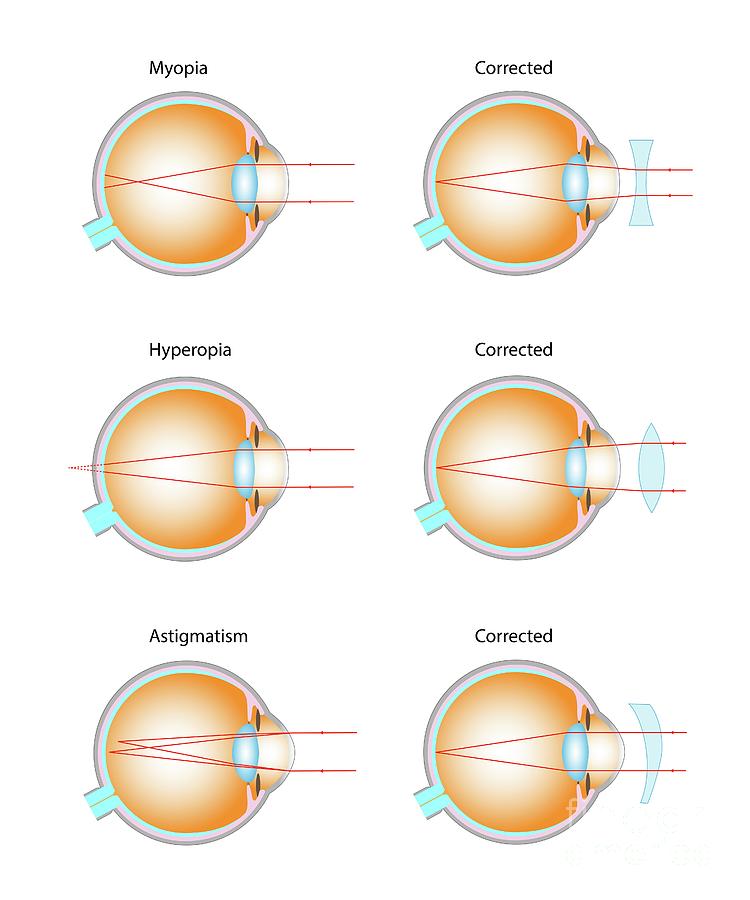
Image source: Science Photo Gallery
Hyperopia (long-sightedness)
Hyperopia, more commonly known as long-sightedness, means that your eyes are shorter than average. This causes the light entering your eye to focus too far back behind the retina which results in blur. For milder levels of hyperopia, some people are able to focus on their tasks with no problems, while for others, it may cause symptoms such as blur, headaches and eyestrain. As hyperopia increases in severity or your workload increases to the extent that your eyes are overworked (e.g. more than 6 hours on screens), the more likely these symptoms will occur. Glasses or contact lenses can alleviate these issues.
How it appears on your prescription:
- Found in the “sphere” section
- Represented with a “+”
- Increases/decreases in 0.25 steps
| Right | Left | |
| Sphere | +0.75 | +1.50 |
| Cylinder | -1.00 | -0.75 |
| Axis | 90 | 90 |
Myopia (short-sightedness)
Myopia, more commonly known as short-sightedness, means your eyes are longer in length than average, meaning the light entering your eye does not focus far enough to reach the retina, resulting in blurry distance vision. In myopia, the eye cannot focus to bring the light to where it should be for clear long-distance vision. However, shorter distances will be clear, depending on the amount of myopia. For more severe myopia, blurry vision will occur at all distances. Therefore, glasses or contact lenses are required to provide clear long vision.
How it appears on your prescription:
- Found in the “sphere” section
- Represented with a “-”
- Increases/decreases in 0.25 steps
| Right | Left | |
| Sphere | -2.50 | -1.50 |
| Cylinder | -1.00 | -0.75 |
| Axis | 180 | 180 |
Astigmatism
Astigmatism is a condition where the front layer of the eyeball (called the cornea), is not perfectly round/spherical like a soccer ball, but shaped more like an oval/rugby ball. This causes light entering your eye to bend differently than it would for a round/spherical eyeball. This can cause blurry vision at both far and short distances, or cause blurriness when looking at fine details.
How it appears on your prescription:
- Found in the “cylinder” section
- Usually represented with a “-”
- Increases/decreases in 0.25 steps
- The axis represents the angle at which the “rugby ball” eye is positioned. The axis will range from 1-180.
| Right | Left | |
| Sphere | 0 | -1.00 |
| Cylinder | -1.00 | -0.75 |
| Axis | 180 | 180 |
Add
Some people might have an extra section on their prescription called an “Add”. This represents an additional boost in strength in addition to the original prescription, usually to help focus on near tasks. This can be required for children struggling to focus at near, or adults with presbyopia.
How it appears on your prescription:
- Found in the “Add” section
- Represented with a “+”
- Increases in 0.25 steps
- Same value in both eyes
| Right | Left | |
| Sphere | +0.50 | +0.25 |
| Cylinder | -1.00 | -0.75 |
| Axis | 180 | 180 |
| Add | +1.00 | +1.00 |
We can help!
If you feel that you are struggling with your vision, or think you have one of the above eye conditions, contact us and we will make our way towards you to check your eyes! We can sort you out with a pair of glasses to improve your vision!